The ARTPARK team presented our livestock disease modelling work at a Gates Foundation event in Delhi earlier this year. The room included national-level officials, senior Gates Foundation leadership including Bill Gates, researchers, and programme heads from across the country. The challenge was not simplification. It was translation: making the purpose of the work legible to people who think in budgets, timelines, and district-level operations rather than compartmental diagrams.
The shift that helped most was starting with the decisions rather than the models. Instead of explaining how a transmission model works, we asked: what questions does a state veterinary officer actually need answered? Where is the disease likely to spread next? Which districts should be prioritised for vaccination? What are the trade-offs between different control strategies? The model exists to help with these questions. Leading with the questions made the model feel like a tool rather than an academic exercise.
We built an interactive prototype for the event. Stakeholders could pick a district, simulate an outbreak, and see how vaccination coverage changed the outcome. This turned out to be more effective than any slide. When someone can manipulate the inputs themselves and watch what happens, the conversation shifts from “do I believe this model” to “what does this model suggest I should do differently.”
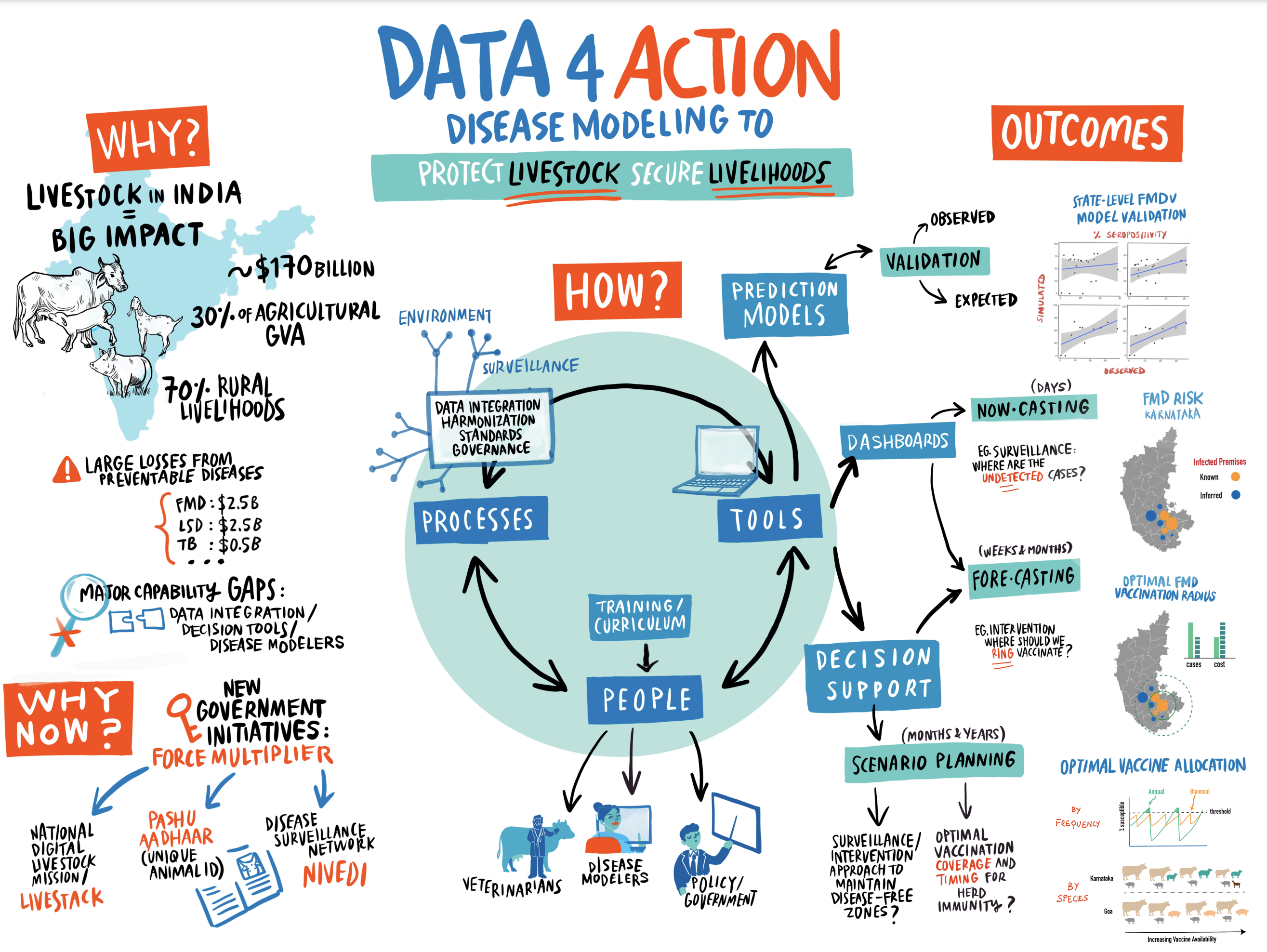
The poster for the event was designed by Carlotta. It captured the initiative’s structure at a glance: data systems, modelling, and capacity building as three connected components.
Key takeaways
The technical quality of a model matters less than I expected in these settings. What matters is whether the people in the room can connect the output to a decision they actually face. Framing is not packaging. It is part of the work.
There is a sentence from Saltelli that I think about often: data do not speak for themselves, and neither do models. The insight depends on context, framing, and purpose. A well-built model that nobody trusts or understands is operationally equivalent to no model at all. The communication is not separate from the science. It is part of the science.
The other thing I learned is that capacity building cannot be an afterthought. If the people who are supposed to use the models were not involved in building them, they will not trust the outputs. Co-development is slow and messy, but it is the only way to make models that survive contact with real institutions.