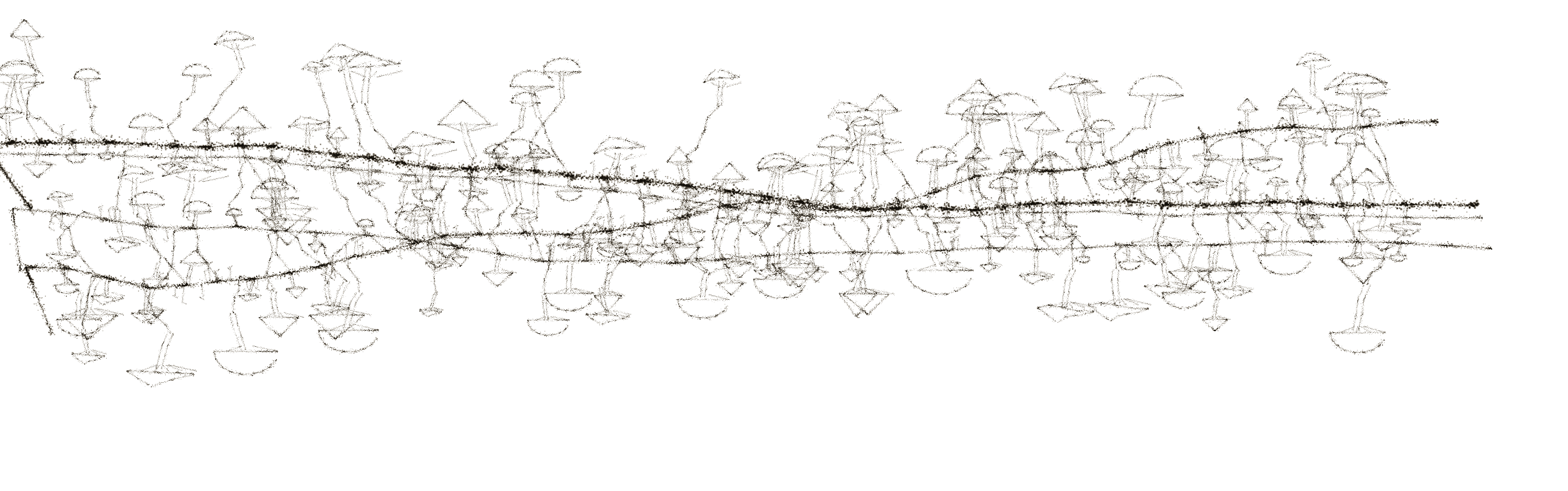
Most of the tools we use for understanding complex systems assume a tree. Organisational charts. Administrative hierarchies. Taxonomies. Compartmental models. We draw boxes with arrows because that is how we write things down.
The problem is that disease transmission does not organise itself into boxes. In a state-level surveillance system, the actual structure is closer to what Deleuze and Guattari call a rhizome: no centre, no hierarchy, connections proliferating sideways. Livestock move between districts following economic networks, not administrative boundaries. Reporting quality depends on which primary health centre has a functional internet connection that week. A policy change in one department alters the data pipeline for a completely different programme, because they share infrastructure that nobody documented.
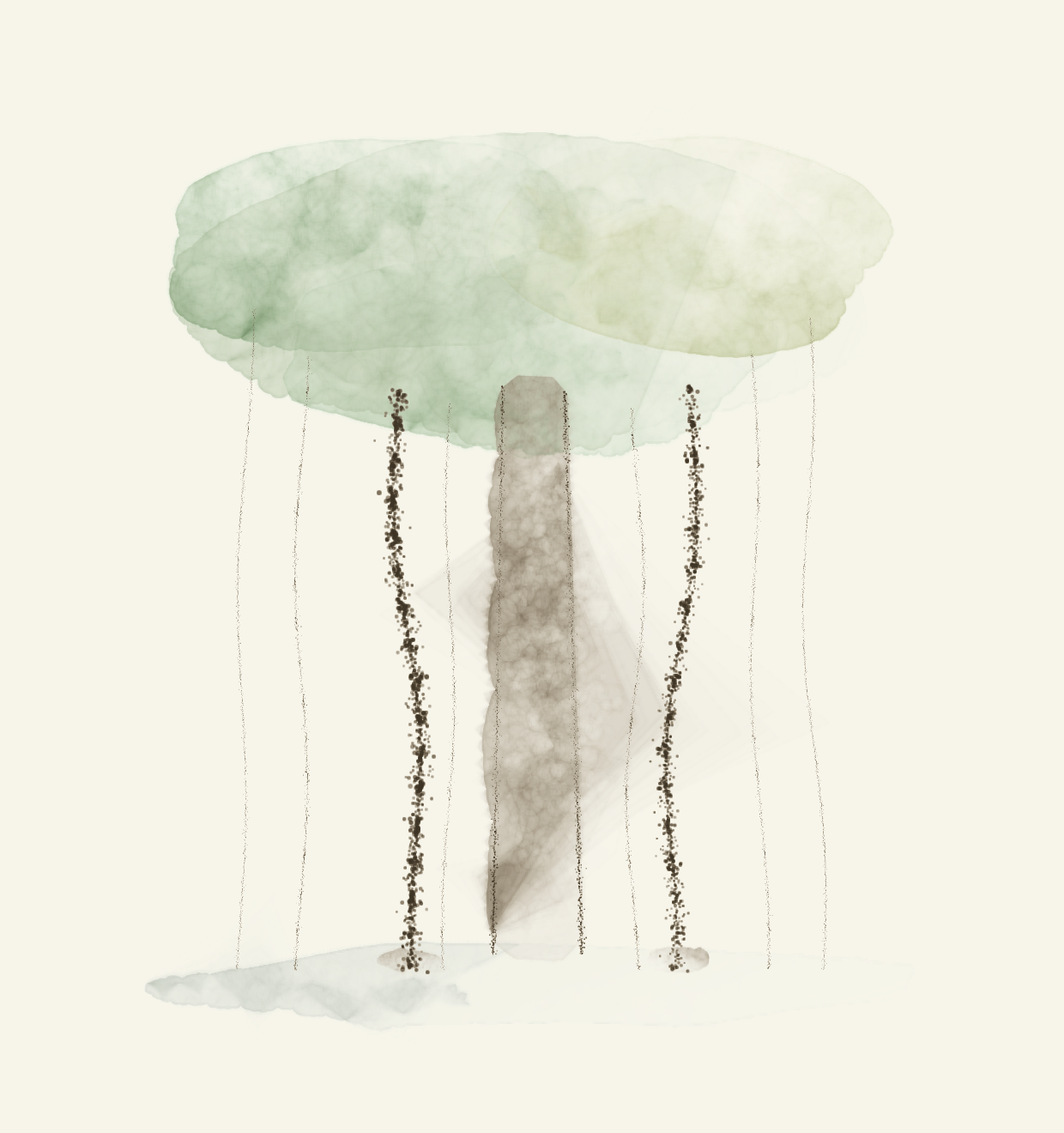
a banyan. the roots come down and become trunks.
When you build a compartmental disease model, you make a set of structural choices. You decide that “susceptible” and “infected” are the distinctions that matter. You decide that what happens inside each compartment is homogeneous enough to average over. You decide which flows between compartments to represent and which to ignore. These choices are usually reasonable. But they are choices, not discoveries, and they carry consequences. Erica Thompson puts it well: a model is a metaphor. You say one thing is like another, and reason about the original using the resemblance. The question is not whether the model is correct but how far you can push it before it breaks. A compartmental disease model captures transmission dynamics but has nothing to say about whether the district health officer will act on the output. Every model is a selective representation, and the selection is where the value judgements live.
Here is a concrete example. In metapopulation models, you need to represent how disease moves between spatial patches. The most common approach is to use commuting data or livestock movement records to build a connectivity matrix. But the resolution of that matrix depends on what data is available, and available data follows administrative units. So the model inherits the spatial hierarchy of the data system, even when the actual transmission network cuts across those boundaries. The result is that two patches in different districts with heavy informal livestock trade between them may appear unconnected in the model, because the movement data was collected at the district level and they fall in different reporting zones.
This is not a minor technical issue. It shapes which districts get flagged as high-risk, which vaccination zones get prioritised, and how resources are allocated. The hierarchy in the model becomes the hierarchy in the response, even when the disease does not respect it.
There is a deeper issue here, which is non-uniqueness. Clauset, Moore, and Newman showed that for any given network, multiple distinct hierarchical structures can fit the data equally well. The hierarchy you choose is not determined by the system. It is one of several possible decompositions, and which one you pick depends on what you are looking for. In disease modelling, this means that the administrative decomposition (states, districts, blocks) and the epidemiological decomposition (transmission clusters, mobility corridors, ecological zones) can both be internally consistent while disagreeing about which connections matter. The model has to pick one. The choice shapes everything downstream.
The point is not that hierarchy is useless. Administrative structures exist for operational reasons, and compartmental models work well for many purposes. The point is that the structure of the model and the structure of the system are different things, and it is worth being explicit about where they diverge. When a model works well, it is easy to forget that the boxes were a choice. When it fails, the divergence is usually where the failure started.